
Streamline HR Operations with Cloud Payroll Systems
Moving payroll to the cloud is not only a technology change. This practical guide explains how HR, finance, payroll, and IT teams can prepare their processes, data, responsibilities, testing, and rollout controls for a successful cloud payroll implementation across Asia.
Key Takeaways
Document the future payroll process before configuring the system.
Assign clear ownership across HR, payroll, finance, IT, and local teams.
Clean and reconcile payroll data before migration.
Test real payroll scenarios, exceptions, reports, and approval workflows.
Roll out according to operational readiness, with clear go-live criteria.
Treat implementation as an operating-model change, not simply a software installation.

A cloud payroll implementation can give regional teams a more consistent way to manage payroll, but technology alone does not resolve fragmented processes, unclear responsibilities, or unreliable data.
For organisations operating across Asia, implementation also needs to accommodate different statutory requirements, payroll calendars, approval structures, and local practices.
The goal is therefore not to make every country operate identically. It is to establish a common operating framework while preserving the local controls each market requires.
The following playbook helps HR and finance leaders prepare for that transition.
1. Define the Future Payroll Process Before Configuration
A common starting point is to document how payroll works today. That is useful, but implementation teams should also decide how they want payroll to work after the transition.
Begin by mapping the complete payroll cycle:
Employee and compensation changes
Time, attendance, leave, and variable-pay inputs
Payroll cut-off dates
Calculation and validation activities
Local and regional approvals
Bank-file and statutory-file preparation
Payslip distribution
General ledger outputs
Post-payroll reconciliation
Error correction and off-cycle processing
The purpose is not to reproduce every existing workaround in the new platform. Each step should be reviewed to determine whether it remains necessary, can be standardised, or should be replaced with a clearer control.
Teams should also document important exceptions. New hires joining after the cut-off date, employees moving between entities, retroactive salary changes, unpaid leave, and final payments may follow different paths from a normal payroll run. These scenarios need to be included in the process design from the beginning.
A useful future-state process answers four questions:
What information is required?
Where does that information come from?
Who reviews and approves it?
What evidence shows that the step was completed correctly?
2. Build a Reliable Payroll Data Foundation
Cloud payroll migration depends on the quality of the underlying employee and payroll data.
Before transferring information, identify the authoritative source for each data category. HR may own personal and employment records, while payroll maintains recurring earnings, deductions, statutory identifiers, and year-to-date balances. Finance may own cost centres, accounting codes, and funding information.
The implementation team should review:
Employee names and identifiers
Employment status and effective dates
Entity and work-location assignments
Salary and recurring pay components
Bank and statutory information
Leave, attendance, and variable-pay inputs
Cost centres and general ledger mappings
Historical payroll balances
Currency and payroll-calendar settings
Duplicate records, missing effective dates, inconsistent naming conventions, and outdated employee information should be resolved before migration. Moving unreliable data into a new system simply transfers the problem.
The team should also decide how much historical information needs to be migrated.
Operational requirements, audit needs, employee access expectations, and applicable record-retention rules may differ by market. Local legal or payroll specialists should confirm jurisdiction-specific requirements.
Every migrated dataset should pass three checks:
Completeness: Are all required records and fields present?
Accuracy: Do the values agree with approved source records?
Reconciliation: Do totals match the existing payroll system and finance records?
3. Establish Clear Ownership Across Functions
Payroll implementation crosses several organisational boundaries. Without clear ownership, decisions can be delayed or important checks may be duplicated or missed.
A practical responsibility model may look like this:
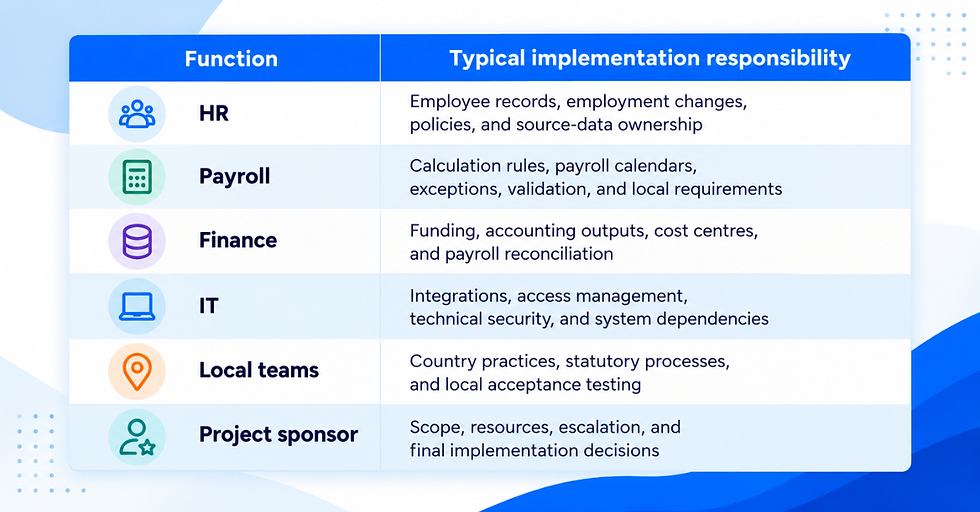
The precise division will vary, but every critical task should have one accountable owner.
Governance should continue after launch. Teams need documented procedures for access reviews, configuration changes, regulatory updates, payroll corrections, and issue escalation. A cloud platform may make changes easier to deploy, but those changes still require appropriate review and control.
4. Test Real Payroll Scenarios Before Go-Live
Testing should confirm more than whether the system can complete a calculation. It should demonstrate that the full payroll process works with the organisation’s actual data, rules, approvals, reports, and exceptions.
A structured testing plan should cover:
Standard payroll scenarios
Test regular salaries, allowances, deductions, statutory contributions, payslips, bank outputs, and accounting reports.
Employee lifecycle events
Include new hires, salary changes, transfers, leave scenarios, terminations, and final payments.
Country-specific requirements
Validate applicable calculations, reports, filing outputs, calendars, and approval practices separately for each market.
Integrations and data transfers
Confirm that employee changes, time information, payroll results, and finance outputs move correctly between systems. Test rejected, incomplete, and duplicated records as well as successful transfers.
Access and approvals
Check that users can perform the tasks required by their roles without receiving unnecessary access to sensitive payroll information.
Parallel payroll runs
Where appropriate, process the same payroll population in both the existing and new systems. Investigate differences at employee, pay-component, statutory, bank-file, and accounting-total levels.
Before testing begins, agree on acceptance criteria. These may include resolved critical defects, reconciled payroll totals, approved country results, completed user training, confirmed integrations, and an agreed support process.
A successful test is not simply one that produces a payroll result. It is one that gives the responsible teams enough evidence to approve go-live.
5. Roll Out According to Operational Readiness
A regional payroll rollout does not need to move every country at once. A phased approach can help teams apply lessons from the first implementation to later markets.
Countries or entities can be grouped according to:
Data readiness
Process maturity
Availability of local subject-matter experts
Integration dependencies
Payroll-calendar timing
Organisational capacity for change
Business risk and operational complexity
The first rollout should be representative enough to test the regional operating model, but manageable enough for the project team to support closely.
Each market should have a documented cutover plan covering final data extraction, validation, user access, approval responsibilities, employee communications, contingency arrangements, and the first live payroll.
Additional support should remain available after go-live. During this period, teams can monitor calculation questions, data issues, user adoption, integration performance, and reporting requirements. Problems should be recorded with clear ownership and resolution dates so that lessons can be applied to subsequent rollouts.
Final Thoughts
Cloud payroll implementation is most effective when process design, data preparation, governance, and testing receive the same attention as the software itself.
For regional HR and finance teams, the objective is not complete uniformity. It is a controlled operating model that provides regional consistency while respecting local payroll requirements.
A well-prepared implementation gives teams a clearer foundation for future payroll automation, system integration, reporting, and regional growth.
If your organisation is planning a cloud payroll transition, ePayslip provides implementation support that includes structured data preparation, migration validation, administrator training, role-based access provisioning, and ongoing assistance. Contact ePayslip to discuss your implementation requirements.


Comments